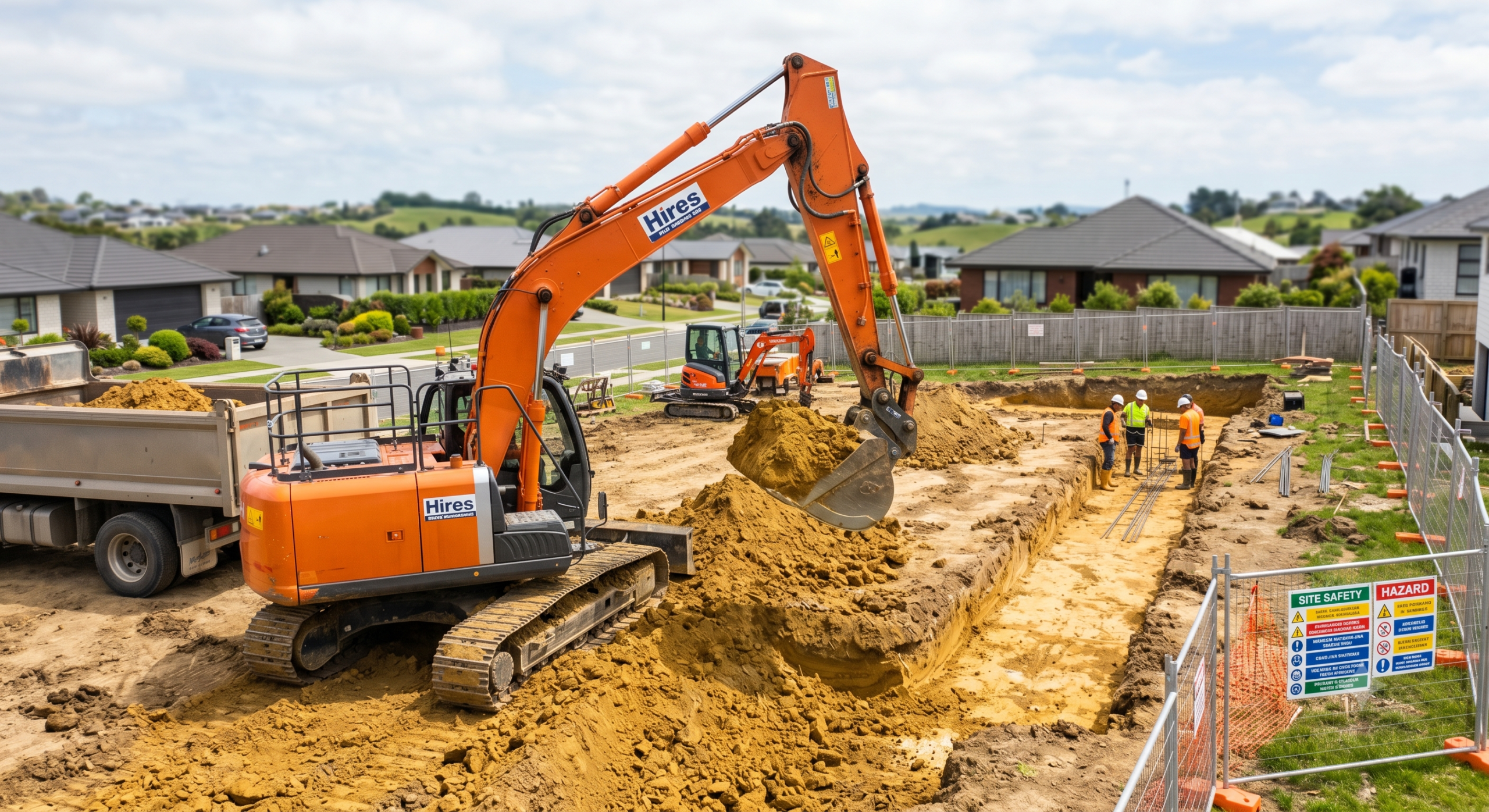
The average cost for standard residential earthworks and excavation in New Zealand ranges from $4,000 to $12,000 for a flat, clean site in 2026. For sloped sections requiring retaining, or sites with poor soil, excavation costs can scale to $20,000 – $50,000+.
Before any framing goes up or concrete is poured, the site must be cleared, levelled, and excavated. Earthworks are the true baseline of any construction project — and one of the highest-risk phases in the build. Below the topsoil sit variables, from hidden rock to soft clay, that can change your budget significantly.
In this guide, a Quantity Surveyor breaks down the realistic 2026 commercial rates for excavation in NZ and the hidden triggers that consistently exceed civil budgets.
Excavator Hire & Operator Rates NZ (2026)
Most small-to-medium residential earthworks are priced on machinery hourly rates plus fixed-rate material disposal. These are current market rates for tracked excavator hire including a licensed operator.
| Machinery Size | Hourly Rate (incl. operator) | Best Used For |
|---|---|---|
| 1.5T – 3.5T mini digger | $110 – $140 / hr | Tight access, utility trenching, minor clearing, sleepout foundations |
| 5T – 8T mid-size excavator | $140 – $180 / hr | Standard house cuts, driveway formation, timber pile holes |
| 12T – 20T heavy excavator | $190 – $260+ / hr | Subdivision cuts, bulk soil shifting, breaking rock, deep retaining bores |
QS Note: Most contractors charge a “float fee” (mobilisation/demobilisation) of $250 – $600+ for mini and mid-size machines, and higher for heavy excavators transported by low-loader. Confirm whether the float fee is included in your hourly quote.
Typical Earthworks Cost by Site Type (2026)
| Site Type | Estimated Cost | What Drives It |
|---|---|---|
| Flat, clean, good access | $4,000 – $12,000 | Standard cut, minimal disposal, easy machine access |
| Gentle slope (cut and fill) | $12,000 – $25,000 | Levelling, increased disposal volume, possible low retaining |
| Steep slope + retaining | $25,000 – $50,000+ | Engineered retaining, heavy machinery, high disposal tonnage |
| Poor soil (undercut required) | $20,000 – $45,000+ | Undercutting soft clay, importing and compacting hardfill |
| Contaminated urban site | $30,000 – $70,000+ | Hazardous soil tracking and regulated disposal |
The Real Cost Driver: Soil Classification & Cart-Away
Homeowners often ask why digging a hole costs so much. The answer is rarely the digging — it is the disposal. When you excavate, soil expands roughly 20–30% in volume (the “bulking factor”). You are billed by the tonne or truckload at commercial facilities, and the price depends on what is in the dirt.
1. Cleanfill / managed fill ($40 – $80 per tonne) Clean, natural clay, soil, or rock with no contaminants. Pristine virgin clay is relatively economical to dispose of.
2. Wet / slurry clay ($90 – $140 per tonne) Earthworks during the NZ winter turn clay into unworkable mud. Landfills charge a premium for wet material because it requires specialised handling and stabilising.
3. Contaminated soil ($150 – $400+ per tonne) Older urban or historically industrial sites (e.g. central Auckland) may contain lead from old paint, hydrocarbons, or asbestos. Contaminated soil must be tracked under strict environmental protocols and disposed of at regulated hazardous waste facilities — significantly increasing your civil budget.
The Hidden Earthworks Variations
Maintain a contingency for these three common sub-surface risks:
Geotechnical surprise (soft ground) If your Geotechnical Engineer finds bearing capacity below 100kPa, a standard slab cannot be poured. The excavator must undercut the soft ground — digging out an extra 500mm–1m of soft clay — and backfill with compacted GAP40/GAP65 hardfill ($60–$95 per tonne delivered and compacted).
Striking hard rock ($250 – $350+/hr) If the digger hits basalt, greywacke, or volcanic rock, standard buckets are useless. A hydraulic rock breaker attachment is required, incurring an immediate surcharge and slowing daily progress significantly.
Retaining wall interdependence A slope greater than 10–15 degrees cannot be cut and filled flat without retaining the earth. A retaining wall over 1.5 metres — or any wall under 1.5m that supports a surcharge (driveway, building, or sloping ground above it) — requires an engineered design and building consent, costing $500 – $1,500+ per lineal metre. See: [Retaining Wall Cost NZ (2026)]
Frequently Asked Questions
Do I need council consent for earthworks in NZ? It depends on your local District or Unitary Plan. Most councils permit a baseline of earthworks (commonly cutting or filling up to a set height, or moving under ~50m³). Exceed those volume or depth thresholds, work near a boundary, or affect an overland flow path, and a Resource Consent for earthworks is required before machinery arrives.
What are sediment controls? By law, mud, silt, and dirty runoff must not enter public stormwater systems or waterways. Budget $1,500 – $3,000 for sediment control — geotextile silt fences, hay bale barriers, and stabilised gravel truck entrances. Council inspectors can issue instant fines of $750 – $1,500 if your site pollutes the street.
How long do standard house earthworks take? For a flat 400m² section with good access and clear weather, stripping topsoil and preparing the gravel raft or drilling pile holes takes 3–5 working days. Slope, poor soil, or rock extends this considerably.
Why is winter earthworks more expensive in NZ? Wet clay is heavier and harder to handle, increasing both machine time and per-tonne disposal cost. Sites also need more sediment control in wet conditions, and weather delays add machine standby time. Where possible, schedule earthworks for drier months.
Can I reduce earthworks costs by reusing the soil on site? Sometimes. If excavated material is clean and your design allows, it can be reused for landscaping fill or levelling elsewhere on the section — avoiding both disposal and import costs. This must be confirmed with your engineer, as fill under any structure requires proper compaction and certification.
Summary: Earthworks & Excavation Cost NZ 2026
| Item | Cost |
|---|---|
| Flat clean site | $4,000 – $12,000 |
| Sloped site with retaining | $25,000 – $50,000+ |
| Mini digger (incl. operator) | $110 – $140 / hr |
| Heavy excavator (incl. operator) | $190 – $260+ / hr |
| Cleanfill disposal | $40 – $80 / tonne |
| Contaminated soil disposal | $150 – $400+ / tonne |
| Hardfill (GAP40/65) | $60 – $95 / tonne |
For broader site preparation and structural budgeting: