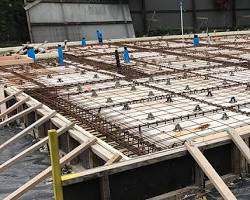
The average cost to pour a standard residential concrete slab foundation in New Zealand ranges from $160 to $260 per m² in 2026. For a standard 150m² single-storey home, expect a total foundation budget of $24,000 to $39,000+, assuming stable ground.
Once earthworks are complete and the site is levelled, the concrete slab forms the physical and structural starting point of the build. It is one of the most material-heavy phases of construction, so its price is highly sensitive to the commercial rates of ready-mix concrete, steel reinforcing, and timber formwork.
In this guide, a Quantity Surveyor breaks down the realistic 2026 market rates for concrete slabs in NZ and the sub-surface risks that trigger heavy contractor variations.
Concrete Slab Cost per m² NZ (2026)
Residential foundations in NZ typically fall into two categories: traditional raft slabs (with deep perimeter footings) and engineered pod floors (such as Firth RibRaft or Golden Bay Waffle systems).
| Foundation Type | Cost per m² | Total (150m² home) | QS Notes |
|---|---|---|---|
| Engineered waffle / pod slab (e.g. RibRaft) | $160 – $210 / m² | $24,000 – $31,500 | Sits on top of the ground using polystyrene pods. Ideal for good ground. Uses less concrete |
| Traditional concrete raft slab | $220 – $270+ / m² | $33,000 – $40,500+ | Requires deep perimeter trenches dug into clay. Higher concrete and excavation volume |
| Complex / sloped site slab | $300 – $450+ / m² | $45,000 – $67,500+ | Requires stepped footings, blockwork base walls, or engineered backfilling |
QS Note on ground classification: In post-earthquake Canterbury, sites are classified TC1, TC2, or TC3 (Technical Category) based on liquefaction risk. A TC3 site requires a more heavily engineered foundation, pushing costs toward the upper end. Outside Canterbury, your geotechnical report determines the foundation specification.
The Commercial Breakdown
A professional concrete sub-contractor’s quote is typically built on four cost centres:
1. Boxing & formwork The temporary timber perimeter shuttering that holds the liquid concrete until it cures. Includes labour to survey, square, and brace the boxing to prevent failures during the pour.
2. Poly pods & steel reinforcing Engineered pod floors use expanded polystyrene (EPS) or plastic pods to create internal voids, reducing total concrete weight. Steel reinforcing mesh (e.g. SE62) and starter bars are placed to give the slab tensile strength against seismic movement.
3. Concrete supply & placement Standard residential slabs use 20MPa–25MPa concrete. Material cost depends on total cubic metres (m³) required. Placement includes the skilled labour to lay, screed, vibrate, and power-trowel the surface to a smooth U3 finish ready for flooring.
4. Concrete pump hire ($150 – $250/hr + travel) Unless ready-mix trucks can back up to every corner of the foundation, a hydraulic boom or line pump is mandatory. Pumps charge an hourly rate plus a “prime and wash” fee of $150 – $300 per pour.
The Hidden Cost Drivers
The slab price can increase significantly if sub-surface conditions do not match the assumptions in the designer’s drawings:
Engineered piling ($150 – $300+ per lineal metre) If the soil report indicates soft peat or uncontrolled fill, a waffle slab cannot sit directly on the ground. The council will require driven timber piles or bored concrete piles to tie the foundation into solid ground. Adding 20–30 piles can add $8,000 – $15,000+ to your foundation bill.
Hardfill sub-base overruns ($60 – $95 per tonne) Before the polythene vapour barrier and steel are laid, the ground must be built up with compacted GAP40 or GAP65 hardfill. If the site was over-excavated or the ground is exceptionally soft, extra truckloads of aggregate are required to build the pad back to compliance height. See: [Earthworks & Excavation Cost NZ (2026)]
Winter weather delays Pouring concrete in a NZ winter introduces delays. Heavy rain before a planned pour can collapse or flood foundation trenches, requiring manual pump-out and a structural engineer re-inspection ($250 – $400/hr) before the council permits the pour.
Frequently Asked Questions
What is the standard thickness of a residential concrete slab? A standard residential floor slab is typically 100mm thick over the internal pods, with deeper external perimeter footings and internal thickening ribs running 200mm–300mm deep depending on the engineering specification.
How long does it take to prep and pour a concrete slab? For a standard 150m² site with clear access, the setup phase — boxing, running internal plumbing drains, laying pods, and tying steel — takes 3–5 days. The physical pour is usually completed in a single morning, taking 3–6 hours.
How long must a slab cure before framing can start? Concrete reaches nominal structural strength at 28 days. However, NZ builders typically begin standing timber wall framing 7 days after the pour, once the slab has cured enough to hold structural anchors without cracking.
What is the difference between a waffle slab and a traditional slab? A waffle (pod) slab sits on top of the ground using polystyrene pods to create voids, using less concrete and requiring less excavation — ideal for good, stable ground. A traditional raft slab requires deep perimeter trenches dug into the ground, using more concrete and excavation. Waffle slabs are now the most common choice for new NZ residential builds on suitable ground.
Does my concrete slab need building consent? Yes. A concrete slab foundation for a new dwelling is structural work and forms part of the building consent for the whole build. The foundation design must be signed off by an engineer and inspected by the council at the pre-pour stage before concrete can be placed. See: [Building Consent Cost NZ (2026)]
Summary: Concrete Slab Cost NZ 2026
| Foundation Type | Cost per m² | 150m² Total |
|---|---|---|
| Engineered waffle / pod (RibRaft) | $160 – $210 | $24,000 – $31,500 |
| Traditional concrete raft | $220 – $270+ | $33,000 – $40,500+ |
| Complex / sloped site | $300 – $450+ | $45,000 – $67,500+ |
| Engineered piling (if required) | $150 – $300+ / lineal m | + $8,000 – $15,000+ |
For adjacent structural budgeting: