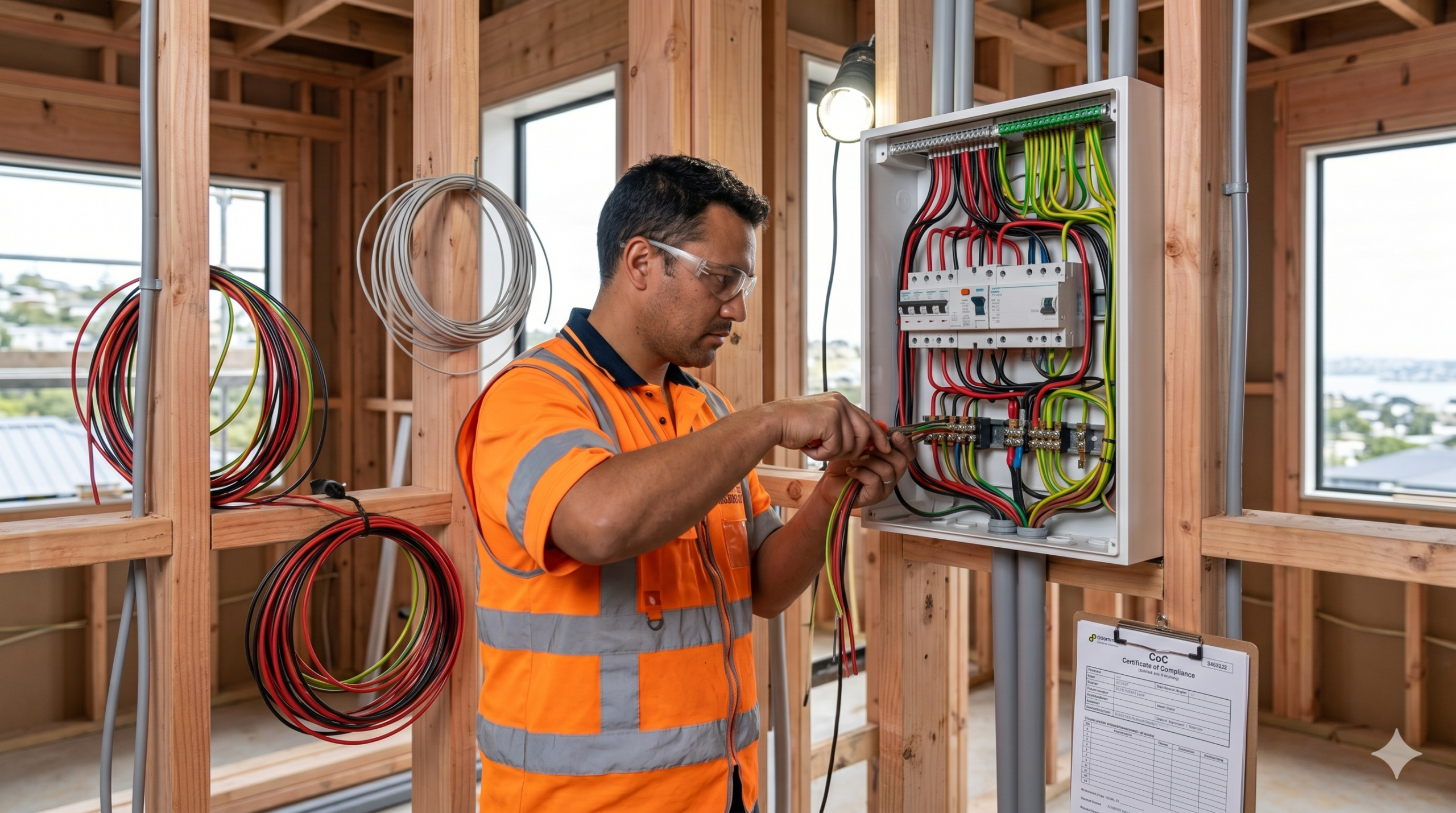
The average hourly rate for a licensed electrician (sparky) in New Zealand ranges from $85 to $130+ per hour in 2026. For a full residential rewire or a new 3-bedroom home installation, the total electrical budget typically sits between $8,000 and $18,000+, depending on layout complexity and fixture selections.
Electrical infrastructure is the unseen nervous system of any residential project. While homeowners focus on light fittings and smart switches, the bulk of the electrical budget is consumed by compliance, heavy-gauge cabling, mains distribution, and skilled labour.
In this guide, a Quantity Surveyor breaks down the realistic 2026 market rates for residential electrical work in NZ, and the hidden costs that consistently push budgets above the baseline plan.
How Electricians Charge in NZ: Hourly vs Per-Point
Residential electrical contractors typically quote using one of two methods.
1. Hourly rate + materials
Best for maintenance, troubleshooting, or small renovations where the full scope cannot be determined upfront.
- Apprentice rate: $50 – $75 / hr
- Registered electrician rate: $85 – $130 / hr
QS Note: Electricians usually charge a vehicle or travel fee of $40 – $90 per day to cover transport and fuel.
2. Per-point pricing (standard for new builds)
For new construction, contractors prefer a flat rate “per point.” A point is any single termination — a light switch, a double plug socket, or a data outlet.
- Standard double power point (GPO): $120 – $180 per point (supply, cabling, plate)
- LED downlight point: $110 – $160 per point (incl. IC-F rated LED fitting)
- Data / TV outlet: $130 – $190 per point
New Build Electrical Packages (2026)
These baseline packages include standard switchboards, LED downlights, double power points, bathroom extraction fans, and compliance certification.
| House Size & Type | Total Electrical Budget | QS Notes |
|---|---|---|
| Small unit / sleepout (under 50m²) | $3,500 – $6,000 | Basic distribution board, 10–15 points, smoke alarms, main supply hook-up |
| Standard 3-bed house (120m²–180m²) | $8,000 – $14,000 | ~40–50 LED downlights, 25 double plugs, basic heat pump wiring |
| Large 4-bed / smart home | $16,000 – $30,000+ | Premium switch plates, external landscape lighting, multi-zone audio cabling |
The Hidden Cost Drivers
To keep your electrical budget under control, watch for these common blind spots:
1. Mains cable inflow & trenching ($2,000 – $5,000+)
Getting electricity from the street pillar to your meter box requires a heavy-gauge underground mains cable. If your house is set back from the road (a rear section or long driveway), you pay significantly per lineal metre for trenching, conduit, and the cable itself.
2. Switchboard upgrades ($1,500 – $3,500)
A major renovation on an older home with an old fuse board legally requires an upgrade to a modern switchboard fitted with Residual Current Devices (RCDs) and miniature circuit breakers (MCBs) to comply with current NZ electrical standards.
QS Note: A full switchboard replacement runs $1,500–$3,500. A smaller sub-board addition or single dedicated circuit (e.g. for a heat pump) is cheaper at $800–$1,500.
3. 3-phase power upgrade ($3,000 – $6,000+)
Standard NZ homes run single-phase power. If your design combines a high-capacity ducted heat pump, instant electric hot water, and a fast EV charger, single-phase may overload. Upgrading to 3-phase requires network approval (Vector, Orion, etc.) and more expensive switchboard components.
4. Mandatory compliance fees — CoC & ESC ($250 – $500)
An electrician must legally test the installation and issue a Certificate of Compliance (CoC) and an Electrical Safety Certificate (ESC). The council will not issue your Code Compliance Certificate (CCC) without these.
Frequently Asked Questions
Can I run the electrical cables myself to save money?
No. In NZ, residential electrical work is strictly regulated under the Electricity Act. Unlicensed DIY fixed wiring is illegal and invalidates your home insurance. All fixed wiring must be carried out, tested, and signed off by a registered professional holding a current practising licence with the EWRB (Electrical Workers Registration Board).
What does “IC-F rated” mean for downlights?
IC-F (Insulation Cover-F) is a safety rating for modern LED downlights. It means roof insulation can be laid directly over the fitting without creating a fire hazard. Specify IC-F rated fittings so your insulation contractor does not have to leave uninsulated gaps around every light — which would compromise your ceiling’s thermal performance.
How much does it cost to rewire an existing house in NZ?
A full rewire of an older 3-bedroom home typically costs $10,000 – $20,000+, depending on access and whether ceiling and wall linings need to be opened. Rewiring is most economical when done during a full renovation while walls are already open. A switchboard upgrade is almost always required at the same time.
How long does it take to wire a new house?
Electrical work happens in two main stages. The “rough-in” (running cables through the open frame before lining) takes 3–5 days for a standard home. The “fit-off” (installing switches, sockets, fittings, and testing) takes a further 3–5 days after the walls are lined and painted.
What is the difference between a CoC and an ESC?
A Certificate of Compliance (CoC) certifies that the electrical work complies with NZ wiring standards. An Electrical Safety Certificate (ESC) certifies that the installation has been tested and is safe to connect. Both are legally required, and your council needs them before issuing your CCC.
Summary: Electrician Cost NZ 2026
| Item | Cost |
|---|---|
| Registered electrician (hourly) | $85 – $130+ / hr |
| Double power point (per point) | $120 – $180 |
| LED downlight (per point) | $110 – $160 |
| Standard 3-bed new build | $8,000 – $14,000 |
| Full rewire (existing home) | $10,000 – $20,000+ |
| Switchboard upgrade | $1,500 – $3,500 |
| 3-phase upgrade | $3,000 – $6,000+ |
| CoC + ESC compliance | $250 – $500 |
For adjacent fit-out budgeting: