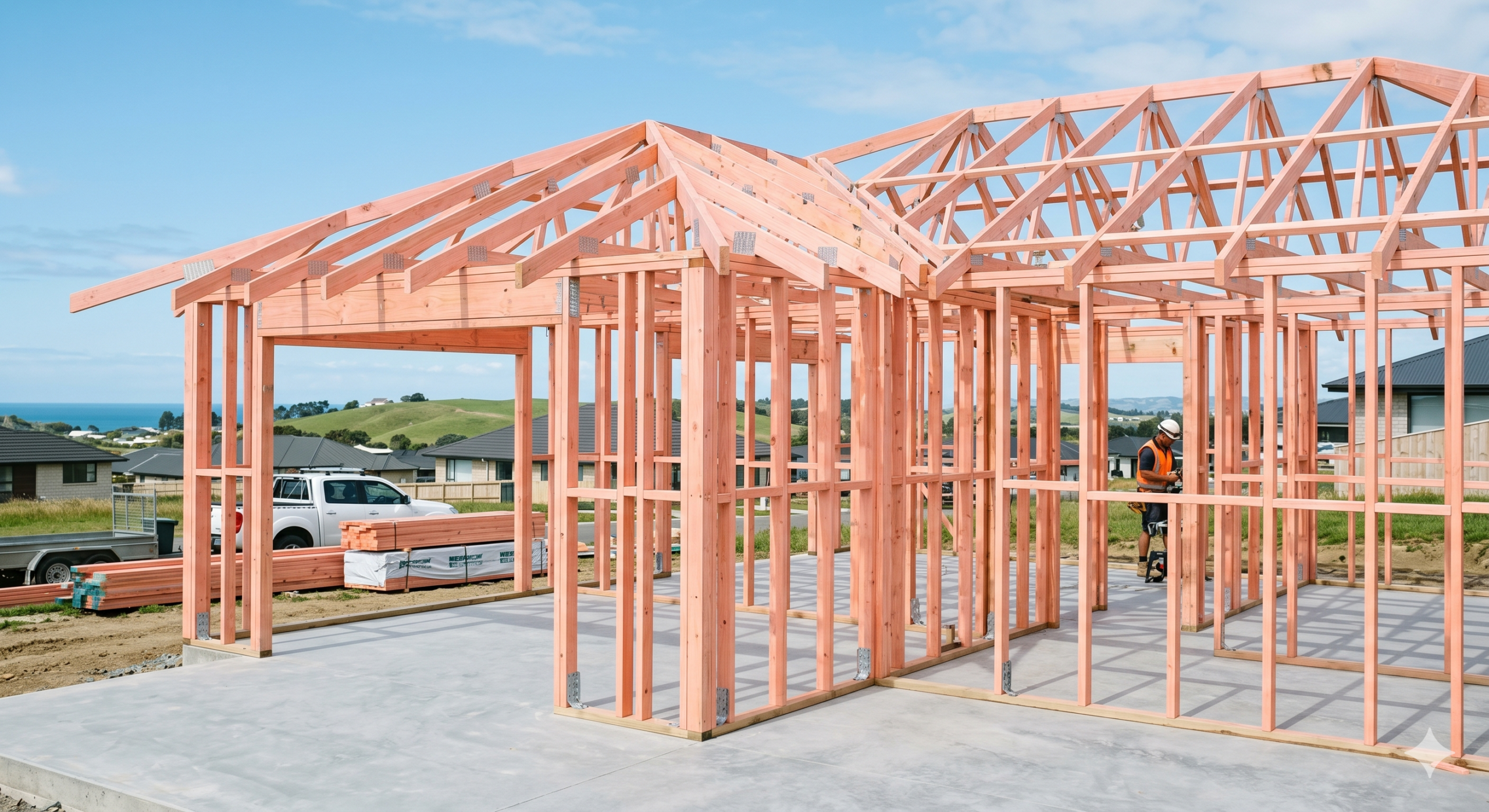
The average cost to supply and install timber framing for a standard residential home in New Zealand ranges from $180 to $300 per m² of floor area in 2026. For a standard 150m² single-storey home, expect a total framing budget of $27,000 to $45,000+ for materials and builder labour.
Once the concrete slab has cured, the house begins to take shape. Timber framing is the structural skeleton of the build. In NZ, the vast majority of residential homes use lightweight timber framing, treated to withstand our climate and seismic conditions.
In this guide, a Quantity Surveyor breaks down the realistic 2026 market rates for framing a house in NZ, and the hidden costs — scaffolding, crane hire, and structural steel — that consistently catch homeowners out.
Typical Framing Cost by House Size (2026)
| House Size | F&T Materials Only | Supply & Stand (incl. labour) |
|---|---|---|
| 120m² | $18,000 – $24,000 | $24,000 – $36,000 |
| 150m² | $22,500 – $30,000 | $27,000 – $45,000 |
| 200m² | $30,000 – $40,000 | $36,000 – $60,000+ |
QS Note: Two-storey homes increase the per m² rate due to upper-floor framing, additional bracing, and extended scaffolding requirements.
Frame & Truss vs Stick-Built
There are two ways to frame a house in NZ. The industry has shifted heavily toward off-site manufacturing to save on high site-labour costs.
1. Pre-fabricated Frame & Truss (F&T) packages
The architect’s plans are sent to a Frame & Truss plant (Carter Holt Harvey, or local ITM/PlaceMakers fabrication yards). Wall panels and roof trusses are engineered, precision-cut, assembled in a factory, and delivered to site via hiab truck.
- Cost: $120 – $180 per m² of floor area (materials only)
- Advantage: Drastically reduces on-site builder hours and minimises weather exposure
2. Stick-built (on-site framing)
The builder orders loose packs of timber and cuts, measures, and nails every stud, dwang (nogging), and plate on the slab.
- Advantage: Suited to bespoke architectural builds, complex hill sites where truck access is impossible, or highly customised renovations
- Trade-off: Significantly higher builder labour hours usually make this the more expensive route
The Budget Breakdown: Materials & Labour
A full “Supply & Stand” framing quote consists of:
1. The timber (SG8 H1.2)
NZ residential framing mandates mechanically stress-graded timber, most commonly SG8. Internal framing must be treated to at least H1.2 hazard class — recognised by its distinct pink colour — to protect against borer and fungal decay.
2. Builder labour rates ($75 – $120+/hr)
Standing the frames requires a team of Licensed Building Practitioners (LBPs) and apprentices. For a standard 150m² F&T package, a crew of three to four builders can stand the ground-floor walls and lift the roof trusses within 5–10 working days.
3. Fixings and hardware ($1,500 – $3,500+)
A house is not held together by standard nails alone. Your structural engineer specifies heavy-duty galvanised brackets, cyclone ties, multi-grips, and hold-down bolts (e.g. Bowmac or Simpson Strong-Tie) to ensure the frame survives earthquakes and high winds.
The Hidden Cost Drivers
The timber itself is rarely the cause of a budget overrun. The major financial risks during framing are:
Structural steel (open-plan designs)
If your design features large sliding doors or open-plan living with no internal load-bearing walls, standard timber cannot carry the roof load. The engineer specifies steel UB (Universal Beams) or flitch beams. A single large steel beam can cost $3,000 – $8,000+ to fabricate, transport, and lift into place via crane.
Scaffolding and edge protection ($4,000 – $10,000+)
Under WorkSafe NZ, builders cannot install roof trusses while balancing on the top plate. Full perimeter scaffolding with edge protection must be erected before the trusses go up.
Moisture content delays (the 18% rule)
Before insulation and GIB board can close the walls, the frame must pass a council pre-line inspection. Timber moisture content must be below 18%. If the frame was exposed to heavy rain, it must dry out — and hiring commercial dehumidifiers and heaters to speed this up can add thousands in unbudgeted preliminary costs.
Frequently Asked Questions
What is the difference between SG8 and SG10 timber?
SG (Structural Grade) refers to the stiffness and strength of the timber. SG8 is the standard for most NZ residential framing. SG10 is stiffer and higher-grade, used for high-load areas such as long-spanning floor joists or heavy load-bearing lintels. SG10 is more expensive.
Can I use untreated timber for framing in NZ?
No. Following the leaky homes crisis of the 1990s and 2000s, the NZ Building Code was updated. All enclosed structural timber framing must now be treated to at least H1.2 (pink) for long-term durability against rot and borer.
How long does it take to frame a house in NZ?
A standard 150m² single-storey F&T package takes a skilled crew 5–10 working days to stand the walls and lift the trusses. Stick-built framing or two-storey homes take considerably longer. Weather and moisture delays can extend this.
Is Frame & Truss cheaper than stick-built?
In most cases, yes. While the materials cost is similar, F&T drastically reduces on-site builder labour hours — the most expensive component. Stick-built is typically only more economical (or necessary) on complex sites where truck delivery access is impossible, or for highly bespoke architectural work.
Does timber framing need building consent?
Yes. Structural framing forms part of the building consent for the whole build. The frame must pass a council framing inspection (and a pre-line moisture inspection) before the walls can be lined. See: [Building Consent Cost NZ (2026)]
Summary: Timber Framing Cost NZ 2026
| Item | Cost |
|---|---|
| F&T package (materials only) | $120 – $180 / m² |
| Supply & stand (incl. labour) | $180 – $300 / m² |
| Builder labour | $75 – $120+ / hr |
| Fixings & hardware | $1,500 – $3,500+ |
| Structural steel beam (each) | $3,000 – $8,000+ |
| Scaffolding & edge protection | $4,000 – $10,000+ |
For adjacent structural budgeting: