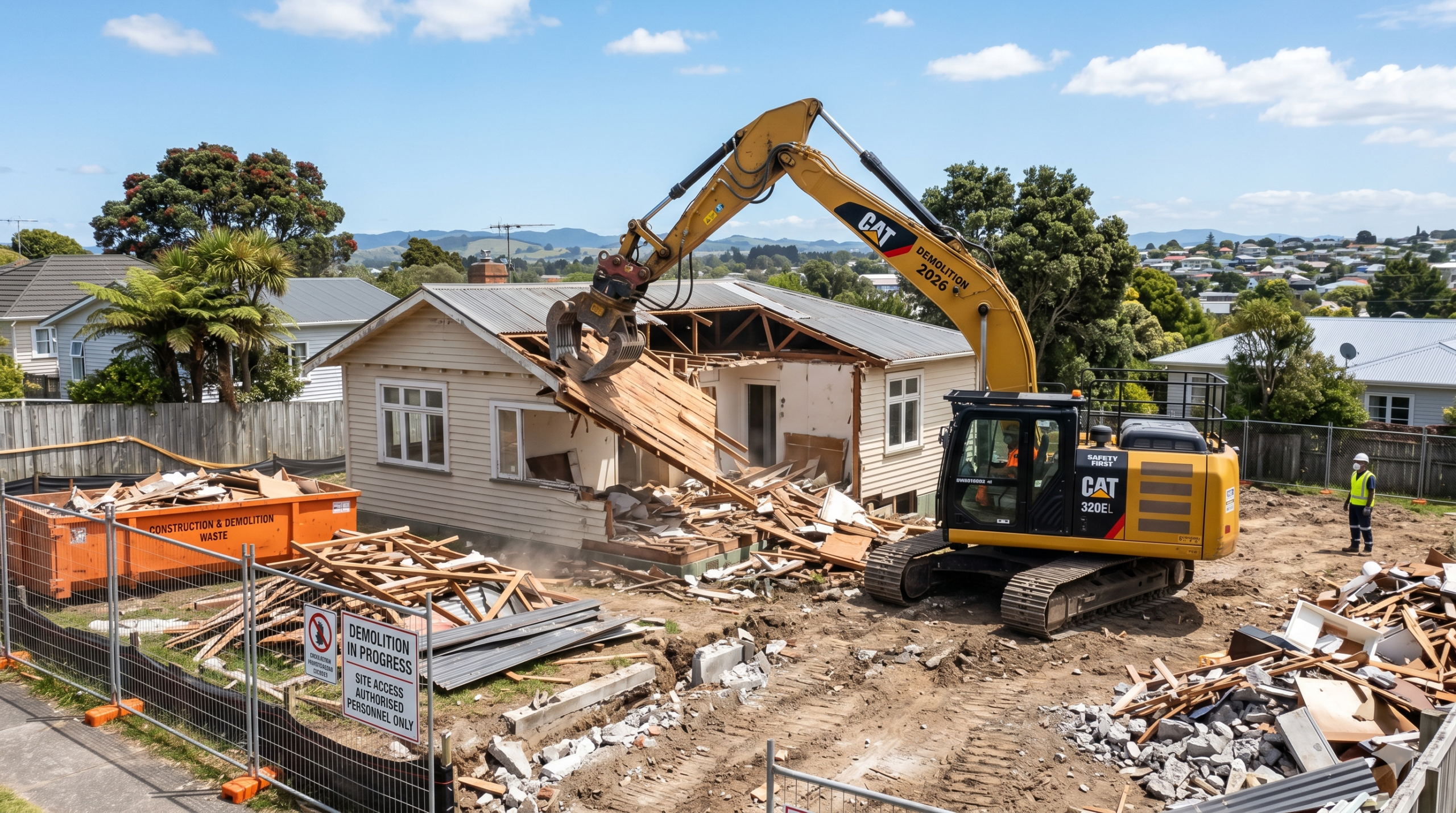
The average cost to demolish a standard 3-bedroom residential house in New Zealand ranges from $20,000 to $45,000+ in 2026. For larger or two-storey homes, or sites with restricted access, total demolition and site clearance costs can exceed $50,000 – $80,000+.
Whether you are clearing a section for a new build or preparing a site for a multi-unit development, demolition is typically the first operational cost on any project. While the physical teardown looks straightforward, the consenting, hazardous material handling, and increasing tipping fees make it one of the most volatile budget line items in residential construction.
In this guide, a Quantity Surveyor breaks down the realistic 2026 rates for residential demolition and the hidden utility and waste costs that must be factored into any feasibility budget.
House Demolition Cost NZ (2026)
These are indicative budgets for complete mechanical demolition and removal of standard residential dwellings to bare ground, assuming standard flat site access.
| House Size & Type | Estimated Cost | QS Notes |
|---|---|---|
| Small house / cottage (under 100m²) | $15,000 – $25,000 | Timber framing, iron roof, single-storey. Excludes asbestos removal |
| Standard 3–4 bed house (100m²–200m²) | $20,000 – $45,000 | NZ baseline. Includes slab/pile removal, site clearance, and transport |
| Large / two-storey house (200m²+) | $50,000 – $80,000+ | Requires heavier machinery, increased waste volume, and extended programme |
| Concrete / brick construction | Add 20–35% to base rate | Hydraulic breakers and pulverisers required — significantly slower cycle times |
What Does an All-In Demolition Budget Look Like?
Most quotes cover mechanical demolition only. Here is a realistic all-in budget for a standard 3-bedroom timber house on a flat Auckland section:
| Cost Item | Estimate |
|---|---|
| Mechanical demolition and site clearance | $20,000 – $35,000 |
| Services disconnection (power, water, gas) | $2,000 – $5,000 |
| Asbestos survey and removal (if required) | $2,000 – $10,000+ |
| Silt fencing and environmental controls | $1,000 – $2,500 |
| Building consent (demolition) | $1,500 – $3,000 |
| Total all-in (indicative) | $26,500 – $55,500+ |
QS Note: Asbestos is the single biggest variable. A pre-2000 home with asbestos cladding, soffits, and textured ceilings can add $8,000–$15,000+ to this budget before the excavator arrives.
The Core Budget Breakdown
A compliant demolition quote covers three distinct phases:
1. Machinery and labour (approx. 40–50% of budget) Covers mobilisation (transporting 12–20-tonne excavators via heavy transport), daily operator rates, and manual labour for soft-stripping internal fixtures before mechanical demolition begins.
2. Trucking and landfill tipping fees (approx. 30–40% of budget) NZ landfill levies and commercial tipping fees have increased significantly due to regional environmental policy. Mixed construction and demolition (C&D) waste is charged by weight. A standard 150m² timber home can generate 40–60 tonnes of waste. If material cannot be separated for recycling, maximum commercial dumping rates apply.
3. Site clearance and slab/pile extraction (approx. 15–20% of budget) Breaking and removing a concrete slab or extracting deeply driven timber piles takes considerable time. If the site requires clean-fill certification for the next build phase, material must be tracked and sorted carefully.
The Hidden Pre-Demolition Costs
Before an excavator can legally enter the site, the following costs must be paid — and are almost never included in a standard demolition quote:
Services disconnection ($2,000 – $5,000+) Live utilities must be formally isolated before demolition. Vector (or your local lines company) must remove the main power meter and cut the supply cable at the boundary. Watercare must cap the water and wastewater connections. Chorus must remove fibre or copper connections. Each network provider charges separately.
Asbestos pre-demolition survey and removal ($1,500 – $10,000+) Under WorkSafe NZ, a comprehensive Refurbishment/Demolition Asbestos Survey is legally mandatory before demolishing any pre-2000 structure. If asbestos is identified, it must be fully removed by a licensed specialist and a Clearance Certificate issued before standard demolition machinery can enter. See: [Asbestos Removal Cost NZ (2026)]
Silt fencing and environmental controls ($1,000 – $2,500) Councils require erosion and sediment controls before any earthworks begin. Geotextile silt fencing and stabilised construction entrances must be installed to prevent debris entering public stormwater drains.
Frequently Asked Questions
Do I need Building Consent to demolish a house in NZ? In most cases, yes. Most residential demolitions in NZ require a Building Consent — your local council needs to confirm hazardous materials are managed, utilities are capped, and public safety is maintained. Requirements vary by council, so confirm with your local authority before proceeding. Do not assume demolition is exempt work.
Can I save money by stripping materials out myself? Yes, to a degree. Removing high-value native timbers (Rimu, Kauri, Matai), character doors, or copper plumbing pipes before the machinery arrives reduces the total waste weight and can generate some resale value. Ensure your contract explicitly states you will complete the soft-strip phase — this affects the demolition contractor’s pricing.
How long does a house demolition take? The physical teardown of a standard 3-bedroom timber house takes 2–4 days. However, the full process — Building Consent, utility disconnections, asbestos clearance, and final site levelling — typically takes 4–8 weeks from start to site-ready.
What happens to the materials after demolition? Demolition contractors are responsible for sorting and disposing of waste appropriately. Concrete and masonry can often be crushed and recycled as clean fill. Timber is typically landfilled unless it is native hardwood. Hazardous materials (asbestos, lead paint) require specialised disposal at licensed facilities.
Can I relocate the house instead of demolishing it? In some cases, yes. Relocating an older timber home can cost $40,000 – $80,000+ depending on distance and condition — sometimes comparable to demolition but preserving the structure. It requires Building Consent at both the original and destination site and is only viable for structurally sound timber buildings. Get relocation and demolition quotes simultaneously before deciding.
Summary: Demolition Cost NZ 2026
| House Type | Demolition Only | All-In (incl. hidden costs) |
|---|---|---|
| Small cottage (under 100m²) | $15,000 – $25,000 | $20,000 – $40,000 |
| Standard 3–4 bed house | $20,000 – $45,000 | $26,500 – $55,000+ |
| Large / two-storey house | $50,000 – $80,000+ | $60,000 – $100,000+ |
For broader site preparation budgeting: