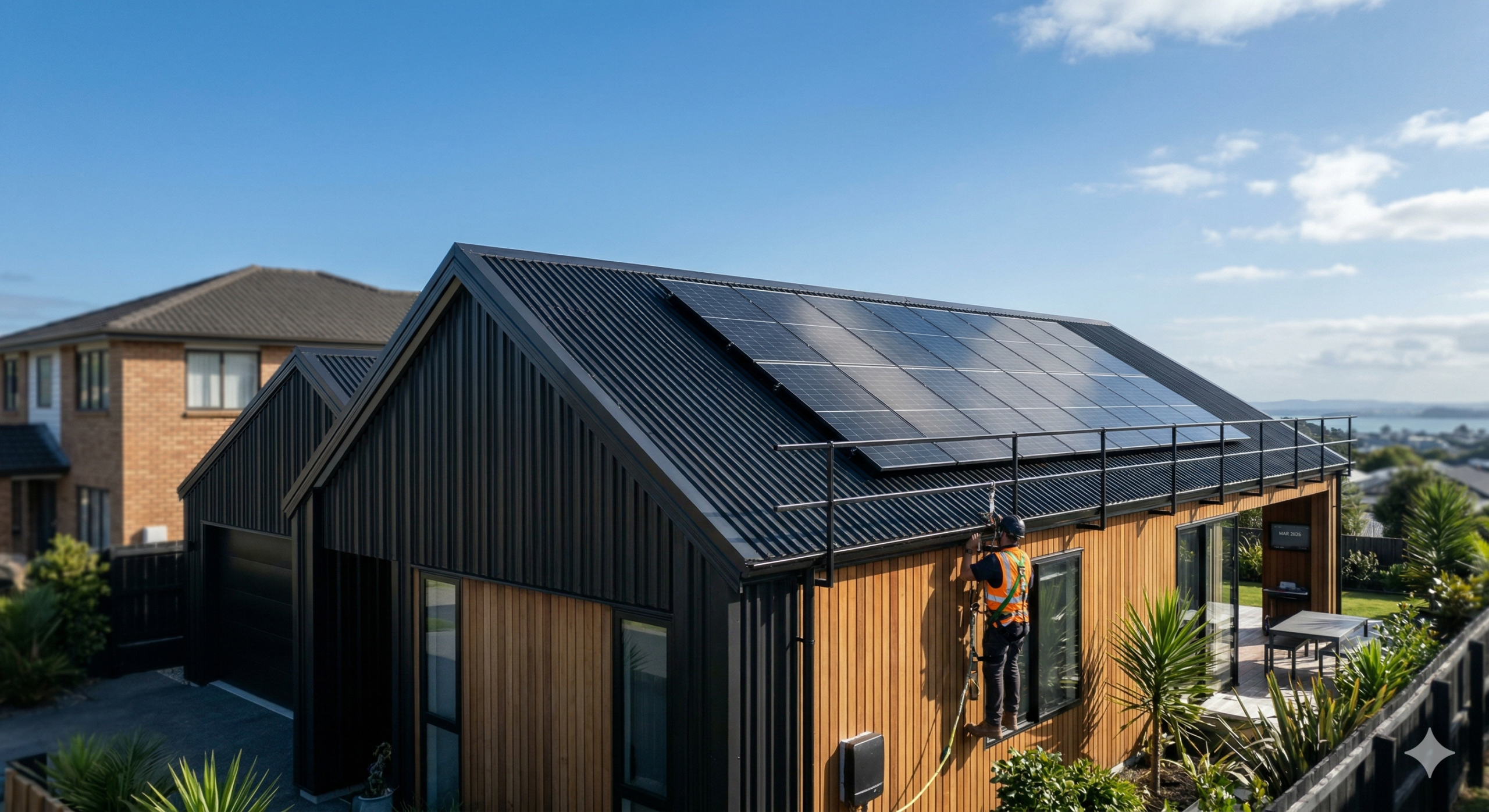
The average cost of a standard 5kW solar panel system in New Zealand ranges from $11,000 to $14,000 fully installed in 2026. Adding a solar battery pushes that budget to $22,000 – $26,000+.
With rising electricity prices, solar power has moved from a premium upgrade to a standard consideration for NZ homeowners. However, solar retailers commonly quote system prices that exclude the site-specific structural and safety costs required to actually get the panels on your roof legally and safely.
In this guide, a Quantity Surveyor breaks down the realistic 2026 prices for solar systems with and without batteries, the ROI reality, and the hidden costs that consistently catch homeowners out.
Solar Panel System Cost NZ (2026)
These rates are fully installed costs (supply and install) for standard grid-tied systems. Rates assume a single-storey home with a structurally sound roof and an up-to-date electrical switchboard.
| System Size | Without Battery | With 10kWh Battery | Suitable For |
|---|---|---|---|
| 3kW system | $8,000 – $10,000 | $18,000 – $22,000 | 1–2 person household, low daytime usage |
| 5kW system | $11,000 – $14,000 | $22,000 – $26,000 | Standard 3–4 bedroom family home |
| 8kW+ system | $16,000 – $20,000 | $28,000 – $35,000+ | Large homes, heavy heat pump use, or EV charging |
Typical Solar Costs by House Size (2026)
| House Size | Recommended System | Without Battery | With Battery |
|---|---|---|---|
| 2-bed | 3kW | $8,000 – $10,000 | $18,000 – $22,000 |
| 3-bed | 5kW | $11,000 – $14,000 | $22,000 – $26,000 |
| 4-bed | 6.6kW – 8kW | $14,000 – $20,000 | $25,000 – $35,000+ |
QS Note: These are indicative ranges for standard installs. Two-storey homes, steep roofs, switchboard upgrades, and complex wiring add to these figures — see Hidden Costs below.
The ROI Reality Check: Battery or No Battery?
The biggest budget decision is whether to include a battery (Tesla Powerwall, BYD, or similar).
Without a battery: A standard 5kW solar system typically pays for itself in 6–8 years through power savings, based on current NZ electricity prices. After payback, the system generates free power for the remaining 17–20 years of its lifespan. This is a straightforward financial case.
With a battery: Batteries currently cost $10,000 – $15,000 to install. Adding one roughly doubles your total budget and extends the payback period to 12–15 years — approaching the lower end of the battery’s warranty period (typically 10 years). Batteries provide genuine value for blackout protection and self-sufficiency, but the financial return alone does not currently justify the cost for most NZ households.
QS Verdict: Install solar now. Add a battery when prices drop further or when your existing battery needs replacement — battery technology and pricing are improving rapidly.
The Hidden Installation Costs
A generic online quote has not accounted for your specific property. Budget for these common additional costs:
1. Edge protection and scaffolding ($1,000 – $2,500+) Under WorkSafe NZ regulations, contractors must have fall protection when working at height. For a single-storey home, perimeter edge protection adds $1,000 – $1,500. For a two-storey home or steeply pitched roof, scaffolding adds $2,000 – $4,000+.
2. Roof condition Solar panels are designed to last 25 years. If your roof is 15+ years old and approaching the end of its lifespan, you will pay to remove and reinstall the entire solar array when the roof is replaced — a cost of $2,000 – $5,000+ just for the solar removal and reinstall, on top of the roofing cost. Always have your roof inspected before committing to solar. See: [Roofing Cost NZ (2026)]
3. Switchboard upgrade and export meter ($800 – $1,500+) To feed power back into the grid, your home requires a specific import/export smart meter and a compliant switchboard. Older switchboards frequently need upgrading before a solar installer can legally connect the system.
4. Tilt brackets for flat or low-pitch roofs ($500 – $1,000) Solar panels require an angle to catch sunlight efficiently and allow rain to self-clean debris. Flat or low-pitch membrane roofs require specialist tilt brackets, adding both material and labour cost.
Grid Connection: What Most Retailers Don’t Tell You
Before your solar system can export power to the grid, you must apply to your local Lines Company (Vector in Auckland, Wellington Electricity, Orion in Canterbury, etc.) for a Distributed Generation connection.
This process is not automatic. In some areas — particularly high-density urban areas — the local transformer may already be at or near capacity. In these cases, the Lines Company can:
- Decline your export application entirely
- Approve export at a reduced capacity
- Require you to fund network upgrades before connection
Ask your installer to confirm grid connection availability for your specific address before you commit. This is a risk that generic online quotes never mention.
Frequently Asked Questions
Do I need building consent for solar panels in NZ? In most standard residential installations, solar panels are exempt from Building Consent under Schedule 1 of the Building Act. However, high-wind zones or unusually heavy mounting systems may trigger a consent requirement. Confirm with your local council if you are in a known high-wind area.
How much can I save on power bills with solar? A 5kW system in a typical NZ location generates approximately 6,500–7,500 kWh per year. At current retail electricity prices of around $0.30–$0.35/kWh, this represents $1,950 – $2,625 in annual savings, assuming you consume most of the generation on-site. Export rates paid by retailers are significantly lower than retail rates.
What happens to my solar system in a power cut? A standard grid-tied solar system without a battery shuts down automatically during a power cut — this is a safety requirement to protect line workers. To maintain power during outages, you need a battery storage system with islanding capability.
How long do solar panels last? Quality panels from reputable manufacturers (LG, SunPower, REC, Jinko) typically carry a 25-year performance warranty guaranteeing at least 80% output at 25 years. Inverters have a shorter lifespan — typically 10–15 years — and should be budgeted for replacement during the system’s life.
Is solar worth it in NZ’s climate? Yes, for most NZ locations. While the South Island and Wellington receive less sunshine than Auckland and Hawke’s Bay, the economics still work across most of the country. The key variable is how much of the solar generation you consume on-site — the higher your self-consumption rate, the faster your payback.
Summary: Solar Panel Cost NZ 2026
| System | Without Battery | With Battery |
|---|---|---|
| 3kW | $8,000 – $10,000 | $18,000 – $22,000 |
| 5kW | $11,000 – $14,000 | $22,000 – $26,000 |
| 8kW+ | $16,000 – $20,000 | $28,000 – $35,000+ |
| Edge protection / scaffolding | $1,000 – $4,000+ | — |
| Switchboard upgrade (if required) | $800 – $1,500+ | — |
For broader home improvement budgeting: