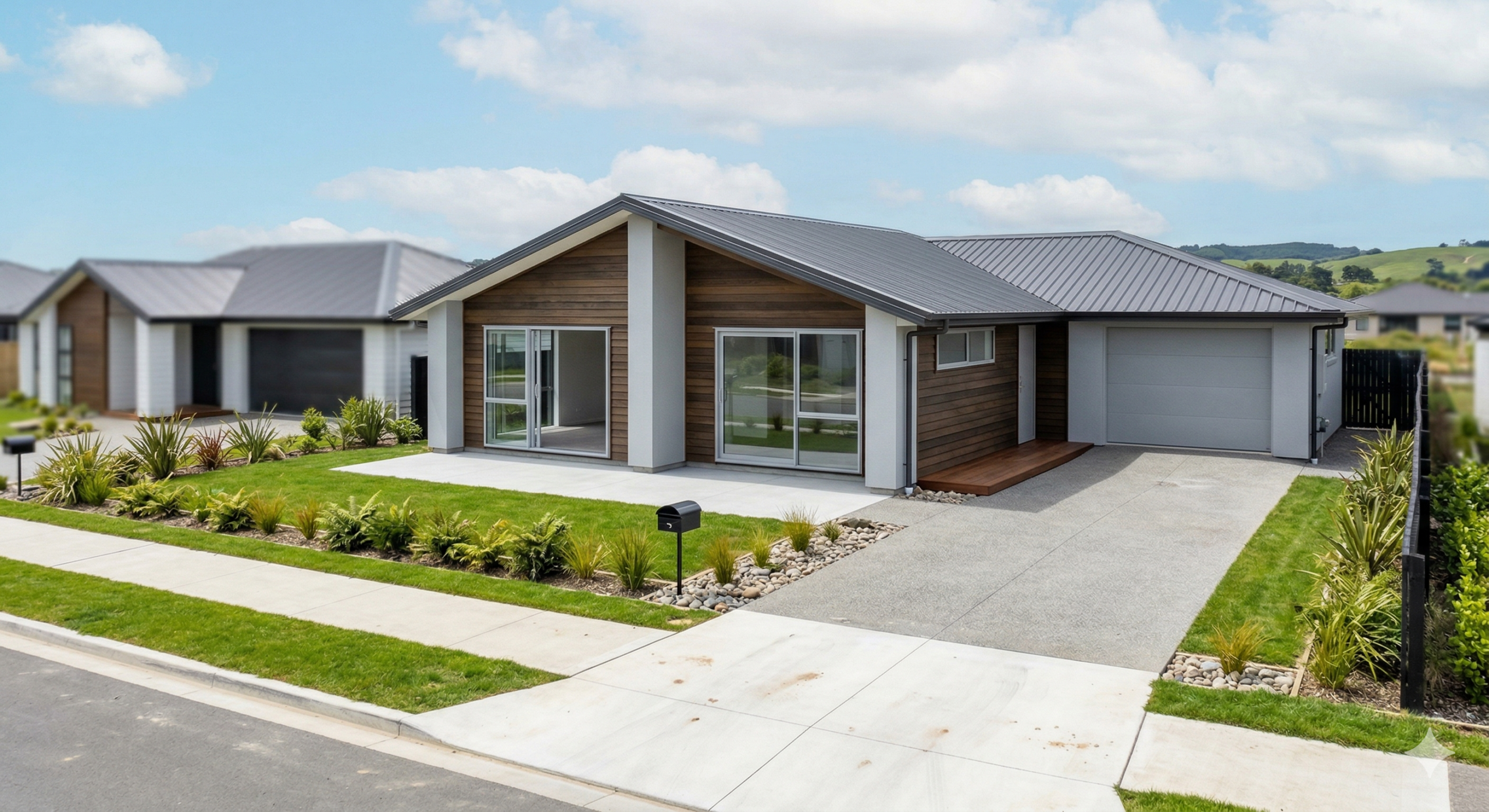
The average cost to build a standard 3-bedroom, 2-bathroom house in New Zealand ranges from $480,000 to $700,000+ in 2026, excluding the cost of land.
When planning a new build, it is easy to be misled by the base prices advertised by volume group builders. While a 3-bedroom home can be built for under $500,000 in the right conditions, that figure rarely represents the final turnkey cost once site works, utility connections, and council fees are added.
In this guide, a Quantity Surveyor breaks down the real 2026 per m² rates, the difference between a base build and a turnkey contract, and the hidden costs that consistently push final budgets above the initial quote.
Build Cost per m² NZ (2026) — 3-Bedroom House
A typical 3-bedroom house in New Zealand ranges from 120m² to 160m² in floor area. The cost per square metre is driven by floor plan complexity, roofline design, and interior specification.
| Build Type | Cost per m² | 120m² Total | 140m² Total | 160m² Total |
| Standard (group builder) | $3,000 – $3,500 | $360,000 – $420,000 | $420,000 – $490,000 | $480,000 – $560,000 |
| Custom / mid-spec | $3,500 – $4,500 | $420,000 – $540,000 | $490,000 – $630,000 | $560,000 – $720,000 |
| Architectural / high-end | $4,500 – $6,000+ | $540,000 – $720,000+ | $630,000 – $840,000+ | $720,000 – $960,000+ |
QS Note: The standard rate assumes a simple rectangular footprint, standard truss roof, basic brick or weatherboard cladding, and entry-level fixtures on a flat, fully serviced site. Any deviation — slope, complex roofline, premium finishes — increases the per m² rate.
Base Build vs Turnkey: The Most Expensive Misunderstanding in NZ Construction
When reviewing a quote from a group builder, the first question to ask is whether it is a Turnkey contract or a Base Build contract. This single distinction can represent a $50,000–$100,000+ difference in what you actually pay.
Base Build covers the physical house from the concrete slab to the roof, including standard interior finishing. It almost always excludes:
- Site preparation and earthworks
- Utility connections from the street boundary to the house
- Driveways, paths, and landscaping
- Council fees and development contributions
Turnkey means the builder delivers a move-in-ready home, but it is critical to review the specification carefully, as provisional sums and exclusions can still apply. Turnkey contracts are typically priced higher per m² but represent a much closer figure to the true all-in cost.
QS Tip: Always ask your builder for a written list of exclusions before signing. If a quote does not explicitly include site works and connections, assume they are excluded.
The Hidden Costs You Must Budget For
Even on a Turnkey contract, the following costs are frequently excluded or underestimated:
1. Earthworks and retaining ($15,000 – $50,000+)
New Zealand sections are rarely flat. If your site requires cutting, filling, or engineered retaining walls to create a level building platform, costs increase significantly. Removing excess clay or soil off-site incurs commercial tipping fees that add up quickly on sloped sections.
2. Utility connections and trenching ($10,000 – $25,000+)
Your house needs to be connected to the street’s infrastructure — wastewater, stormwater, town water supply, electricity, and fibre. These trench runs are measured and charged by the metre. If your site requires a wastewater pump station due to gradient, add a further $5,000 – $10,000.
3. Council fees and development contributions ($15,000 – $45,000+)
Building consent and resource consent fees typically run $5,000 – $10,000+. If your project involves a subdivision or is in Auckland, Council Development Contributions and Watercare infrastructure growth charges can add $15,000 – $35,000+ on top. In Auckland, these costs are non-negotiable and must be paid before the CCC is issued. Confirm these figures with your council before committing to a section.
4. Hard landscaping: driveway, paths, and outdoor areas ($20,000 – $45,000+)
A Code Compliance Certificate (CCC) — the document your council issues when construction is complete and compliant — cannot be obtained without proper stormwater management. This typically requires finished hard landscaping including a concrete driveway and paths. These are almost never included in a group builder’s base price. See [Driveway Cost NZ (2026)] and [Concrete Patio Cost NZ (2026)] for current rates.
5. Design and consents ($15,000 – $35,000+)
Even with a group builder’s pre-designed plans, engineering, soil reports, and consent processing add cost before construction starts. Custom or architectural builds carry significantly higher design fees.
What Does a 3-Bedroom House Actually Cost All-In?
For a realistic all-in budget on a standard spec 3-bedroom build on a straightforward section:
| Cost Item | Estimate |
| Base build (140m² group builder) | $420,000 – $490,000 |
| Earthworks and retaining | $15,000 – $30,000 |
| Utility connections | $10,000 – $20,000 |
| Council fees and development contributions | $15,000 – $35,000 |
| Driveway, paths, and landscaping | $20,000 – $35,000 |
| Design and consents | $10,000 – $20,000 |
| Total all-in (indicative) | $480,000 – $700,000+ |
QS Note: These are indicative ranges for a flat, well-serviced Auckland or main-centre section. Sloped sections, remote locations, or premium specifications will push costs significantly higher.
Frequently Asked Questions
What is the cheapest way to build a 3-bedroom house in NZ?
The most cost-effective approach is a pre-designed rectangular floor plan from a group builder on a flat, fully serviced section. Keeping the footprint simple — minimising corners, avoiding complex rooflines, and using standard fixtures — is the single biggest driver of cost reduction. Any deviation from standard plans incurs drafting and variation fees.
How long does it take to build a 3-bedroom house in NZ?
From slab pour to practical completion, a standard group builder home takes 16–24 weeks. The design, engineering, and council consent phase prior to construction typically adds 3–6 months. Allow 9–12 months from land purchase to move-in on a straightforward project.
Do I need a Quantity Surveyor for a 3-bedroom house build?
For a group builder turnkey contract under $600,000, a full QS service may not be necessary. However, an independent QS review of the contract — particularly the provisional sums, exclusions list, and variation clauses — is worthwhile before you sign. It is significantly cheaper to identify scope gaps before construction than during it.
What is a Code Compliance Certificate (CCC)?
A CCC is the document issued by your local council confirming that the completed building work complies with the approved building consent. You cannot legally occupy or sell a new home without one. Your builder is responsible for obtaining the CCC, but the cost of achieving it — including completing all required site works — is your responsibility. Delays in completing external works are one of the most common reasons CCC issuance is held up.
Is it cheaper to buy an existing house or build new in NZ in 2026?
In most markets, buying an existing home is cheaper upfront. However, a new build offers modern insulation, double glazing to current H1 standards, a 10-year Master Build Guarantee, and significantly lower maintenance costs in the first decade. The decision depends on your section cost, design preferences, and timeline.
Summary: Cost to Build a 3-Bedroom House NZ 2026
| Build Type | Cost per m² | 140m² All-in (indicative) |
| Standard group builder | $3,000 – $3,500 | $480,000 – $600,000+ |
| Custom / mid-spec | $3,500 – $4,500 | $580,000 – $720,000+ |
| Architectural / high-end | $4,500 – $6,000+ | $700,000 – $950,000+ |
For a complete new build budget, price the site works separately, or compare with renovation costs:
4 thoughts on “Cost to Build a 3-Bedroom House NZ (2026): $480,000–$700,000+ QS Guide”