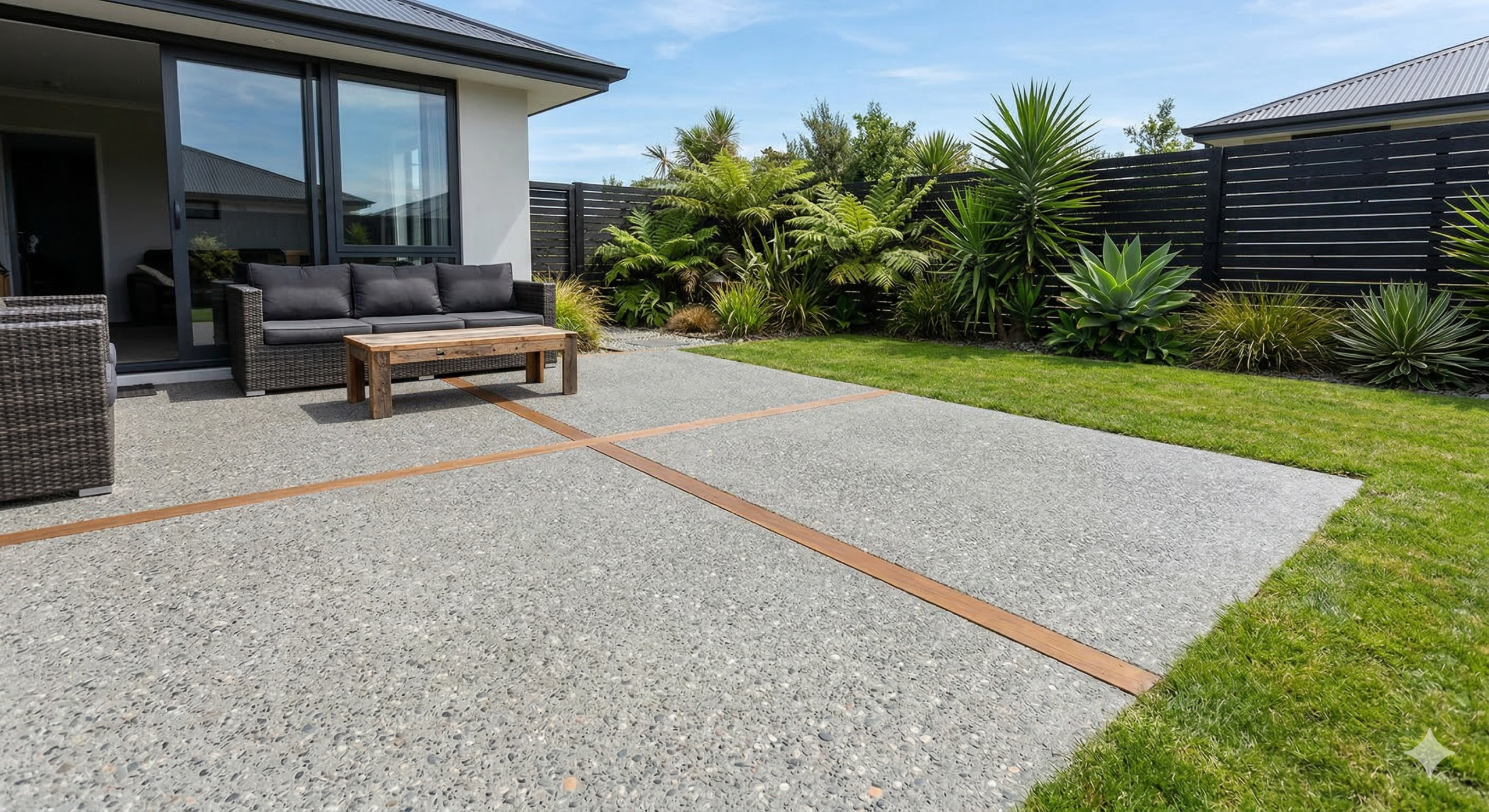
The average concrete patio cost in New Zealand ranges from $120 to $300+ per square metre in 2026, with most homeowners spending between $3,000 and $15,000 depending on site conditions, slab thickness, and the chosen finish.
A concrete patio is one of the most cost-effective outdoor investments a Kiwi homeowner can make — low maintenance, long-lasting, and on a flat site almost always cheaper than a timber deck. But the final price depends heavily on what happens before the concrete truck arrives.
In this guide, a Quantity Surveyor breaks down the real 2026 rates by finish type, typical project budgets by size, and the hidden cost drivers that catch most homeowners out.
How Much Does a Concrete Patio Cost per m² in NZ? (2026)
The biggest price driver is the decorative finish. These rates assume a standard 100mm slab with mesh reinforcement on a reasonably flat, accessible site.
| Concrete Finish | Cost per m² (Installed) | What’s Included |
|---|---|---|
| Standard plain concrete | $120 – $160 / m² | 17.5–20MPa mix, mesh reinforcement, smooth trowel finish |
| Coloured (oxide) concrete | $150 – $190 / m² | Integral colour oxide, standard mesh, control joints |
| Exposed aggregate | $190 – $250+ / m² | Decorative aggregate mix, surface wash, professional sealing |
| Honed / polished concrete | $220 – $300+ / m² | Diamond ground finish, sealing — premium indoor-outdoor look |
QS Note: These are installed rates including labour, materials, and basic excavation on a flat site. Steep sections, poor access, or complex shapes will push costs toward the upper end or beyond.
Concrete Patio vs Timber Deck: Which is Cheaper?
On a flat or near-flat section, concrete almost always wins on upfront cost. A plain concrete patio at $120–$160/m² is roughly three times cheaper than a standard pine deck at $350–$500/m². Over a 20-year period, concrete also wins on maintenance — no oiling, no board replacement, no structural checks.
The exception is an elevated or sloped site. Once significant earthworks and retaining are required, the price gap closes quickly.
👉 For a full comparison, see: [Deck Cost NZ (2026): Pine vs Kwila vs Composite]
Typical Project Costs by Size (NZ 2026)
| Project | Size | Estimated Total |
|---|---|---|
| Garden shed base (plain) | 10m² | $1,500 – $2,000 |
| Small entertaining area (plain) | 20m² | $2,500 – $4,000 |
| Standard patio (exposed aggregate) | 25m² | $5,000 – $7,500 |
| Large outdoor living area (exposed) | 50m² | $10,000 – $15,000 |
| Premium honed finish + pergola base | 60m² | $15,000 – $22,000+ |
QS Tip: If you’re combining a patio with a pergola or outdoor structure, always price the concrete first — it sets the level, the drainage falls, and the structural post positions for everything above it. See: [Pergola Cost NZ (2026)]
Where Does the Money Actually Go?
Most homeowners assume the cost is mostly concrete. In reality, the material itself is often the smaller half of the budget. Here’s how a typical $6,000 exposed aggregate patio (25m²) breaks down:
| Cost Component | Typical % | Approx. Cost |
|---|---|---|
| Labour (placers & finishers) | 35 – 40% | $2,100 – $2,400 |
| Concrete supply (m³) + aggregate | 25 – 30% | $1,500 – $1,800 |
| Excavation & basecourse preparation | 15 – 20% | $900 – $1,200 |
| Reinforcement (mesh & bar) | 5 – 8% | $300 – $480 |
| Sealing, boxing, waste & margin | 5 – 10% | $300 – $600 |
Labour and site preparation consistently account for over 50% of the total. This is why quotes vary so widely — two contractors using identical materials can produce very different final prices based on their labour rates and site prep standards.
The Hidden Cost Drivers
1. Excavation depth and soil type If your site has deep topsoil, clay, or fill material, the concreter needs to cut deeper and import more basecourse (GAP20 or GAP40 compacted gravel). Each additional 50mm of depth adds approximately $15–$25/m² to your total.
2. Site access If a concrete pump truck cannot get within a reasonable distance of the pour — over a fence, down a steep driveway, or across a lawn — wheelbarrow time adds up significantly. Budget an extra $500–$1,500 for restricted access sites.
3. Sealing For coloured and exposed aggregate concrete, sealing is not optional. It is the difference between a finish that lasts 25 years and one that fades and stains within three. Professional sealing adds $15–$25/m² and belongs in your original budget, not as an afterthought.
4. Expansion joints In New Zealand’s climate, concrete moves. Properly placed control joints (every 3–4 metres) and perimeter expansion joints prevent random cracking. This is a labour detail that budget contractors routinely skip. Ask your contractor explicitly how they’re handling joint placement before you sign anything.
5. Stormwater compliance New impermeable surfaces must not increase stormwater runoff onto neighbouring properties or council drains. For larger patios, your local council may require a drainage channel or soakpit. Budget $500–$2,000 if this applies — and ask your contractor whether they’ve considered it, because many won’t raise it unless you do.
6. Breaking out existing concrete If there’s an existing slab to remove, add $30–$60/m² for break-out and disposal. Pouring new concrete over an unprepared existing slab almost always leads to cracking and delamination — it’s not a shortcut worth taking.
How to Get a Reliable Quote
Getting three quotes is standard advice — getting three comparable quotes is what actually matters. When you contact concreters, provide this exact brief so you’re comparing apples with apples:
- Slab dimensions (length × width in metres)
- Finish type (plain / coloured / exposed aggregate / honed)
- Thickness (100mm standard residential, 150mm if any vehicle loading)
- Site access (describe honestly — truck access, steps, gates, lawn)
- Existing surface (turf to strip? Old concrete to remove?)
Ask each contractor to itemise their quote — concrete supply separate from labour, excavation separate from boxing. A single lump sum with no breakdown is a yellow flag.
Which Concrete Finish is Right for Your Project?
Plain concrete — Best for shed bases, utility slabs, and areas out of direct view. Lowest cost, fully functional, no visual interest.
Coloured oxide concrete — Best for entertaining areas where you want warmth without a premium price. Earth tones (sandstone, charcoal, terracotta) are most popular in NZ. Specify UV-stable oxides — standard oxides can fade noticeably over 10+ years.
Exposed aggregate — Best for pool surrounds, driveways, and main entertaining areas. Superior slip resistance, hides dirt well, and ages well. The most popular premium finish for NZ homeowners.
Honed / polished concrete — Best for indoor-outdoor flow areas where the patio reads as an extension of an interior floor. Requires precise subcontractor skill and ongoing sealing maintenance. Premium price, premium result.
Frequently Asked Questions
Do I need building consent for a concrete patio in NZ? In most cases, no. A ground-level concrete patio is exempt work under the Building Act. However, your new impermeable surface must comply with your council’s stormwater coverage rules. If the patio sits beneath a covered pergola with structural connections to the house, consent may be required for the pergola element — not the slab itself.
How thick should a residential concrete patio be? 100mm with mesh reinforcement is the standard specification for foot-traffic areas. If you need to drive a vehicle onto the slab — even occasionally — specify 150mm with F72 mesh or deformed bar. This is not something you can fix after the pour.
How long does a concrete patio last in NZ? A well-placed and properly sealed slab should last 25–40 years with minimal maintenance. The main failure points are poor basecourse preparation (subsidence), missing expansion joints (cracking), and unsealed exposed aggregate (surface erosion).
Is exposed aggregate concrete better than plain concrete? Exposed aggregate is a decorative choice, not a structural one. It does not make the patio stronger, but it provides superior slip resistance — particularly valuable around pools — and hides dirt and leaves far better than standard grey concrete. It is the preferred premium finish in NZ for good reason.
Can I DIY a concrete patio? Boxing a basic square and ordering ready-mix is manageable for a confident DIYer on a small plain slab. Exposed aggregate and coloured concrete are not beginner territory — the wash-off timing on exposed aggregate is critical, and mistakes in concrete are permanent. For anything decorative, hire a professional placer and finisher.
Summary: Concrete Patio Cost NZ 2026
| Finish Type | Cost per m² |
|---|---|
| Plain concrete | $120 – $160 |
| Coloured concrete | $150 – $190 |
| Exposed aggregate | $190 – $250+ |
| Honed / polished | $220 – $300+ |
| Typical 25m² project (exposed aggregate) | $5,000 – $7,500 |
A concrete patio is rarely the end of the project — it is the foundation for a full outdoor transformation. Once the slab is in, the typical next steps are a shade structure, landscaping around the perimeter, and lighting.
If you are planning the full package, build your budget from the ground up:
2 thoughts on “Concrete Patio Cost NZ (2026): $120–$300+ per m² QS Guide”