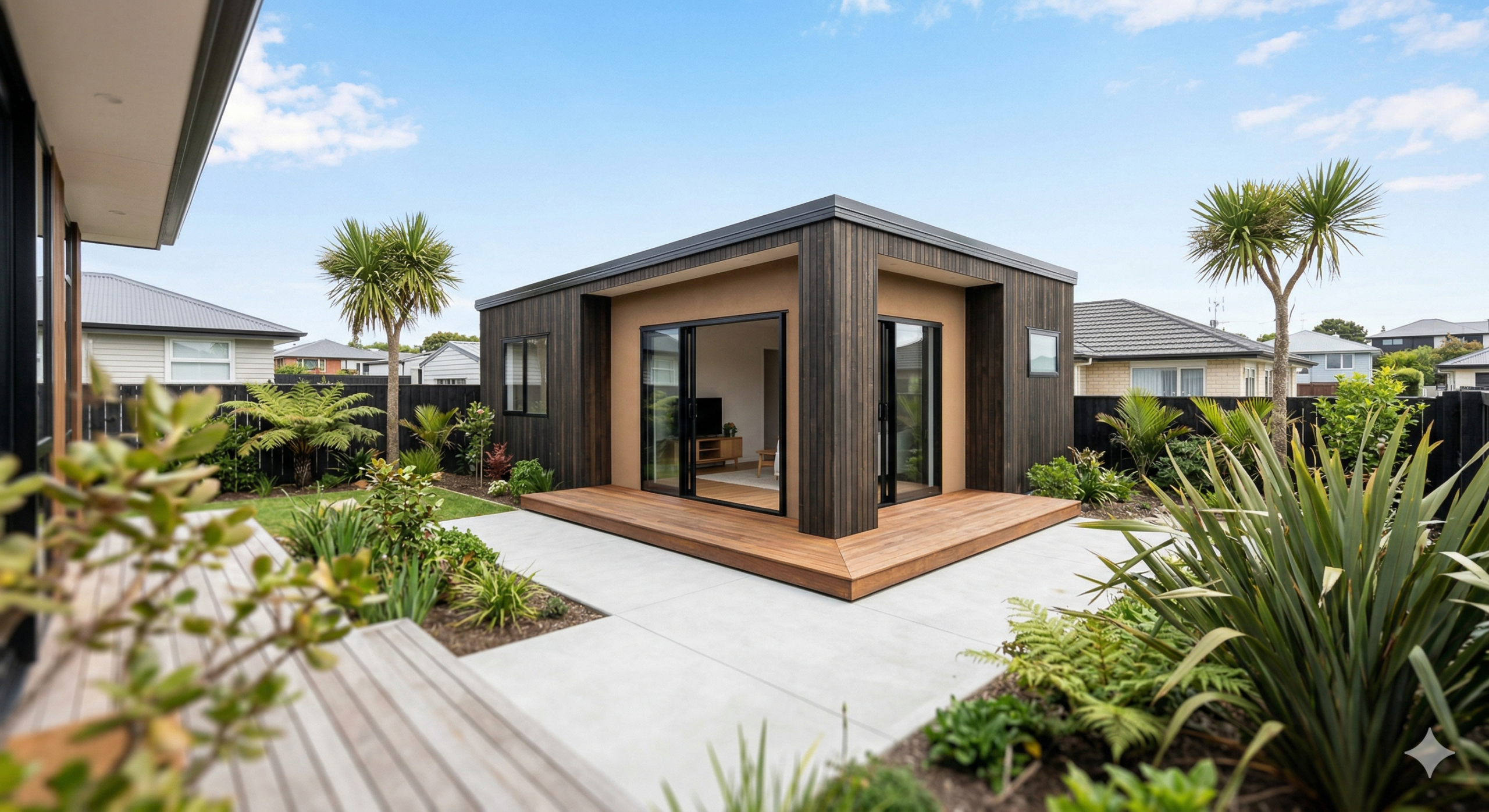
The average cost to build a granny flat in New Zealand in 2026 ranges from $120,000 for a basic transportable unit to $250,000+ for a custom-built 70m² dwelling, excluding site works and utility connections.
Building a minor dwelling has become increasingly popular as homeowners look to maximise their existing land for rental income or extended family living. The 2023 Building Act changes around consent exemptions have changed the cost and timeline picture — but not in the way most people think.
In this guide, a Quantity Surveyor breaks down the real 2026 build costs, per m² rates, and the site works that consistently catch homeowners out.
Understanding the 70m² Consent Rules (2026)
Before looking at numbers, it is critical to understand what the 70m² exemption actually means — and what it does not mean.
What the exemption covers: Under the Building (Exempt Work) Amendment regulations, a detached dwelling of up to 70m² may be built without a standard Building Consent, provided all of the following conditions are met:
- Single storey construction only
- Work is carried out or supervised by a Licensed Building Practitioner (LBP)
- The structure meets all NZ Building Code requirements
- Foundation design is signed off by a Chartered Professional Engineer (CPEng) where required
What the exemption does NOT cover:
- Resource Consent — still required in most residential zones depending on your District Plan or Unitary Plan. Check with your local council before assuming you can proceed
- Plumbing and drainage connections — must still be done by a licensed plumber and connected to council infrastructure legally
- Covenants — some titles have deed restrictions that prevent additional dwellings regardless of consent rules
What does this save you? If your project qualifies for the exemption, you avoid:
- Building consent fees: $5,000 – $12,000+
- Council processing time: 4–8 weeks
QS Note: Never assume the 70m² exemption applies to your site without checking your specific zoning and title conditions first. The savings are real, but the rules have specific triggers that must all be satisfied simultaneously.
Granny Flat Build Costs NZ (2026)
These are fully completed estimates including fit-out, but excluding major earthworks and utility connections — see Hidden Costs below.
| Build Method | Estimated Cost | Pros & Cons |
|---|---|---|
| Kitset / transportable (prefab) | $120,000 – $170,000 | Fast and cost-effective, built off-site. Limited design flexibility and requires clear crane access to site |
| Custom on-site build | $160,000 – $250,000+ | Tailored to your section, highly customisable, premium finish. Longer programme and exposed to weather delays |
| Garage conversion | $90,000 – $130,000 | Cheapest option as the shell exists. Requires slab damp-proofing upgrade, full insulation, and Healthy Homes compliance for plumbing and ventilation |
Typical Granny Flat Costs by Size (2026)
| Size | Custom Build | Transportable |
|---|---|---|
| 40m² (1-bed studio) | $100,000 – $140,000 | $80,000 – $110,000 |
| 60m² (1–2 bed) | $150,000 – $200,000 | $110,000 – $150,000 |
| 70m² (2-bed — max exemption size) | $175,000 – $250,000+ | $130,000 – $170,000 |
QS Note: These figures exclude site works, utility connections, landscaping, and driveway. In practice, add $20,000 – $50,000+ to any of the above for a complete all-in budget.
Granny Flat Cost per m² NZ (2026)
Average: $2,500 – $4,000+ / m²
At first glance, this looks lower than the $3,000–$7,000+/m² rate for a full-sized house build. But the comparison is misleading — a large architectural home pulls the average up with premium finishes across a big footprint. For a standard spec build, a granny flat and a small house sit at a similar per m² rate, and in some cases the granny flat costs more per m² than a comparable standard-spec home.
The reason is the same regardless: economies of scale. A kitchen and bathroom are the two most expensive rooms in any build. In a 200m² family home, those wet area costs are diluted across a large footprint of cheaper bedrooms and living spaces. In a 65m² granny flat, those same plumbing, waterproofing, cabinetry, and tiling costs are concentrated into a very small footprint — driving the per m² rate up relative to the size.
The Hidden Costs: Site Works and Connections
If you buy a $130,000 transportable unit, your total project budget is not $130,000. The single biggest variable in minor dwelling projects is connecting the new building to your existing infrastructure — and this is almost never included in a prefab supplier’s advertised price.
Utility trenching ($10,000 – $25,000+) You need to dig trenches from the new dwelling to the main house or street boundary for:
- Wastewater and stormwater
- Potable water supply
- Power and data
If your section slopes away from the street, gravity drainage may not be possible and a wastewater pump station may be required — add $5,000 – $8,000+ for this alone.
Earthworks and retaining ($5,000 – $25,000+) Most NZ sections are not flat. Cutting into a slope, levelling a pad, and building timber or concrete retaining walls adds cost before the foundation is even poured. Get a site assessment before committing to a budget.
Foundation ($8,000 – $20,000+) Concrete slab on good ground is the cheapest option. If your site has poor bearing capacity, fill, or is on a slope, an engineered foundation system increases this cost significantly.
Driveway and landscaping Most tenants will need vehicle access and a parking space. A concrete driveway or access path adds to the overall cost. See [Driveway Cost NZ (2026)] and [Landscaping Cost NZ (2026)] for current rates.
Is a Granny Flat a Good Investment?
A well-planned minor dwelling can generate strong returns, but the numbers need to be stress-tested properly.
Example calculation (70m² custom build):
| Item | Amount |
|---|---|
| Build cost (all-in including site works) | $220,000 |
| Weekly rent | $550/week |
| Annual gross rent | $28,600 |
| Gross yield on build cost | 13.0% |
QS Note: This is gross yield on build cost only. It does not account for financing costs, annual maintenance, council rates apportionment, insurance, or vacancy periods. Run a full cash flow analysis before making a financial commitment based on these figures.
How to Get a Reliable Quote
When approaching builders or prefab suppliers, be specific about what is and is not included in their price:
- Is the quote supply-only or fully installed?
- Does it include foundations, or is that separate?
- Does it include utility connections and trenching?
- Is Resource Consent included in the project management fee?
- What is the consent pathway — exempt or full building consent?
A prefab supplier quoting $130,000 and a builder quoting $190,000 may be pricing entirely different scopes. Confirm the inclusions before comparing.
Frequently Asked Questions
Do I need Resource Consent for a granny flat in NZ? This depends entirely on your zone and local District Plan or Unitary Plan. In many residential zones, a minor dwelling is a permitted activity and does not need Resource Consent. In others, it requires consent or is not permitted at all. Check with your local council or a planning consultant before proceeding.
Can I rent out a granny flat on a 70m² exempt consent? Yes — the Building Act consent exemption does not restrict whether you can rent the dwelling. However, if you are renting it out, the unit must comply with the Healthy Homes Standards (heating, insulation, ventilation, moisture ingress, and draught stopping).
How long does it take to build a granny flat in NZ? A transportable unit can be installed and connected in 8–16 weeks from order. A custom on-site build typically takes 4–8 months from groundbreaking to completion, depending on complexity and council processing time for any consents required.
What size is best for a rental granny flat? A 60–70m² two-bedroom layout offers the best balance of build cost and rental return in the NZ market. Studios under 40m² have a narrower tenant pool. Going over 70m² triggers Building Consent requirements and increases build cost significantly.
What is the difference between a granny flat and a sleepout? A sleepout has no plumbing — no kitchen or bathroom. It is significantly cheaper to build ($40,000–$80,000) but cannot be legally rented as a standalone dwelling. A granny flat is a fully self-contained minor dwelling with its own kitchen, bathroom, and utility connections.
Summary: Granny Flat Cost NZ 2026
| Build Method | Estimated Total (incl. site works) |
|---|---|
| Garage conversion | $110,000 – $160,000 |
| Transportable / kitset (70m²) | $150,000 – $210,000 |
| Custom on-site build (70m²) | $200,000 – $300,000+ |
| Cost per m² | $2,500 – $4,000+ |
For broader project context:
1 thought on “Granny Flat Cost NZ (2026): $120,000–$250,000+ QS Price Guide”